From administering Microsoft 365 to leading digital governance: a necessary evolution

Aitor García · 13 min read
Also in Spanish
The Microsoft 365 owner is moving from running the platform to governing identities, devices, data, costs and AI. Seven dimensions, six pillars and a practical path.
Leadership summaryIf this is all you read.
The risk. Governing Microsoft 365 only as a productivity platform leaves identities, devices, data, costs and AI without an owner, even though they now converge in the same ecosystem.
The impact. AI speeds up the problem: an assistant finds in seconds what current permissions already exposed, and every agent adds identity, permissions, data, cost and oversight.
The decision. Assign ownership, metrics and visibility over the whole ecosystem, starting with an inventory and a baseline before scaling AI.
For the people rolling it out ↓
On this page
For years, the person responsible for Microsoft 365 had a fairly clear job: manage users, handle licenses, configure services, keep the platform running and resolve incidents.
It was, to a large extent, a technical and operational role.
That model worked when Microsoft 365 could be understood mainly as a business productivity platform. Email in Exchange Online, collaboration in Teams, storage in OneDrive and SharePoint, the Office apps and a few other services.
But that picture has changed.
Today, Microsoft 365 is part of a much broader ecosystem where digital identities, devices, corporate information, SaaS applications, cybersecurity, compliance, artificial intelligence and business processes converge.
And when the ecosystem changes, the way it’s governed has to change too.
As I see it, we’re witnessing a natural evolution of the Microsoft 365 owner: from platform administrator to, progressively, a director of digital governance.
I’m not necessarily talking about adding a new position to the org chart tomorrow. I’m talking about recognizing that responsibilities once centered on technology operations now require a far more cross-functional view.
Because administering technology is no longer enough.
Now we need to understand who uses the resources, how they use them, what information they can access, from which devices, at what level of risk, at what cost and with what impact on the business.
And artificial intelligence is accelerating this transformation.
Microsoft 365 is no longer just Microsoft 365
One reason this change is necessary is that it’s increasingly hard to say where a company’s Microsoft environment begins and ends.
Think of a typical user.
Their identity is probably managed in Microsoft Entra ID. Their computer may be managed with Microsoft Intune. Their email is in Exchange Online. They collaborate in Microsoft Teams, store information in SharePoint and OneDrive, use the Microsoft 365 apps and may well have access to Microsoft 365 Copilot.
Around them are SaaS apps, external guests, groups, permissions, mobile devices, enterprise applications, automations, agents and many repositories of information.
So behind what we used to call simply “administering Microsoft 365” there is now a whole ecosystem of technology decisions.
And that ecosystem keeps growing.
Microsoft’s 2025 Work Trend Index Annual Report was built on data from 31,000 workers in 31 countries, LinkedIn labor trends and trillions of Microsoft 365 productivity signals. It shows how fast AI is making its way into business operations.
82% of the leaders surveyed said 2025 was a pivotal year to rethink key aspects of their strategy and operations, and 81% expected agents to be moderately or extensively integrated into their AI strategy within the next 12 to 18 months.
That radically changes the role of IT.
Seven dimensions behind this evolution
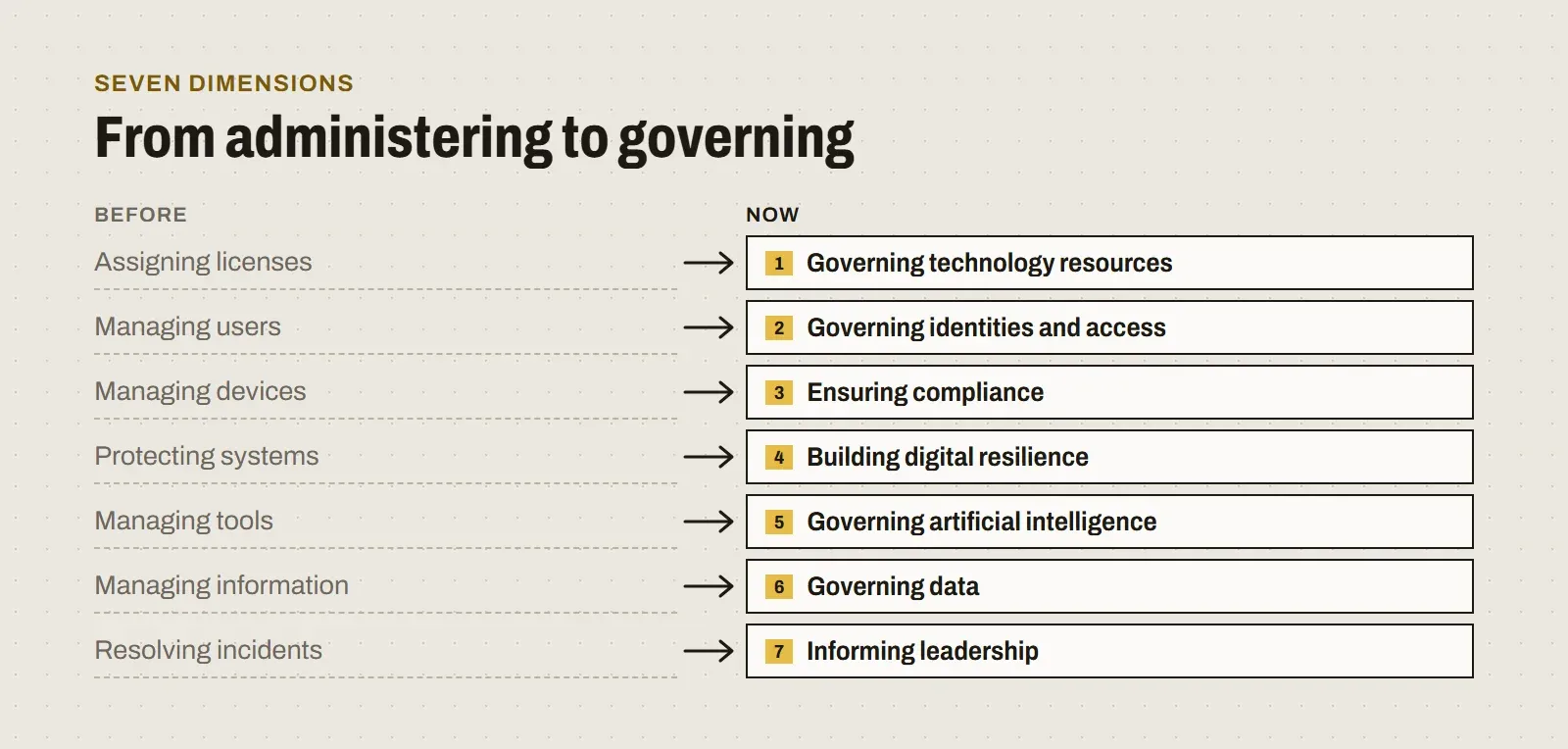
1. From assigning licenses to governing technology resources
For a long time, one of the Microsoft 365 administrator’s traditional tasks was assigning and removing licenses.
But a mature organization needs to answer far more important questions:
- What licenses do we have?
- Who uses them?
- Which features does each user actually consume?
- Are any licenses oversized?
- Do we have users with assigned services they hardly use?
- Are there duplicate SaaS applications?
- Which services are growing fastest?
- Which new tools are being bought outside IT’s control?
- How much are we really spending per user?
- Can we tie that cost to usage and value?
This problem isn’t unique to Microsoft.
Flexera’s 2025 State of the Cloud Report found that 84% of respondents saw managing cloud spend as their top cloud challenge. Organizations also expected that spend to grow by 28% over the following year.
The same study found cloud budgets already exceeding limits by 17%. And 59% of organizations were using or expanding FinOps teams to regain control of those costs.
That leaves us an important lesson:
Assigning a license is administration. Understanding its consumption, cost, need and value is governance.
That’s why I believe organizations should start treating Microsoft 365 under principles similar to FinOps and Software Asset Management.
It’s not about removing licenses indiscriminately.
It’s about making data-driven decisions.
2. From managing users to governing identities and access
A few years ago, user administration was usually thought of as a cycle: joiner → mover → leaver.
Today that view falls short.
A digital identity can have access to email, documents, enterprise applications, confidential information, cloud resources and, increasingly, AI assistants and agents.
Identity has become one of the central controls of the digital ecosystem.
That calls for different questions:
- How many global administrators are there?
- Do those accounts really need those privileges?
- Do we use MFA?
- Are we moving toward phishing-resistant methods?
- Which accounts remain inactive?
- Which external guests still have access?
- Is there standing access that should be temporary?
- Which applications have permissions over our data?
- Do we have service accounts or non-human identities nobody oversees?
- What happens to privileges when someone changes roles?
Industry data shows why this shift matters.
In its Digital Defense Report 2025, which covers July 2024 to June 2025, Microsoft reported that identity-based attacks rose 32% in the first half of 2025 alone, and that more than 97% were large-scale password attacks.
The conclusion matters:
Identity is no longer just a user account. It has become a fundamental security perimeter.
In a modern governance model, technologies such as Microsoft Entra ID, Conditional Access, Privileged Identity Management, Identity Protection and Access Reviews stop being isolated pieces and become parts of a continuous identity governance strategy.
3. From managing devices to ensuring compliance
Something similar happens with devices.
Knowing how many computers exist no longer answers the questions an organization needs answered.
We need to know: are they trustworthy devices?
A device can be correctly registered in an inventory and still be a risk.
That’s why modern management needs to look at:
- encryption;
- operating system versions;
- updates and patching;
- antivirus and EDR;
- firewall;
- corporate configuration;
- compliance;
- outdated devices;
- personal devices;
- endpoint risk.
This is where platforms such as Microsoft Intune, Microsoft Defender for Endpoint and Microsoft Entra ID start working together.
Device information can even influence an access decision.
For example: a user can have valid credentials and MFA properly set up, but if they try to sign in from a device that doesn’t meet corporate policy, the organization can choose to restrict that access.
That’s an important conceptual shift.
We no longer manage only devices. We manage the level of trust from which corporate information is consumed.
4. From protecting systems to building digital resilience
We also need to change how we talk about security.
For a long time we looked at cybersecurity mainly from a preventive angle: how do we stop an attack?
Today’s reality demands a second question: how ready is the organization to keep operating when something happens?
The Microsoft Digital Defense Report 2025 warned of increasingly fast and sophisticated attacks and noted that destructive campaigns targeting the cloud had risen by 87%.
The report also places Zero Trust and resilience among the defensive priorities: assume a breach can happen and design the organization to keep operating and recover.
That means digital governance has to include questions such as:
- Do we have visibility into our risks?
- Do we know our privileged identities?
- Do we know which information is critical?
- Can we detect anomalous behavior?
- Are there recovery procedures?
- How long would it take us to respond to an incident?
- Do we know the business’s critical dependencies?
Security then stops being only technical configuration.
It becomes enterprise risk management.
5. From managing tools to governing artificial intelligence
This is probably the most important shift of the coming years.
With Copilot and AI agents, a new layer appears in the technology ecosystem.
And with it come new questions:
- Who has access to AI?
- Which models and applications does the organization use?
- What information can an agent query?
- Which permissions does it inherit?
- What confidential information can it find?
- Which external tools are being used without authorization?
- How do we measure adoption?
- How do we assess productivity?
- How do we control risk?
- How do we demonstrate return on investment?
The 2025 Work Trend Index Annual Report found that 24% of leaders said their companies had already deployed AI organization-wide, while just 12% remained in pilot mode.
The problem is that AI doesn’t only increase productivity.
It also expands the governance problem.
An employee may take hours to find a given piece of information. An AI assistant can find it in seconds if existing permissions allow it.
That’s why there’s a principle I consider fundamental:
Copilot doesn’t create the permissions problem by itself. It can make a governance problem that already existed far more visible.
Before deploying AI at scale, organizations need to review permissions, confidential information, SharePoint sites, memberships, sharing links and external access.
AI turns a good information governance strategy into a business requirement.
6. From managing information to governing data
There’s another dimension I consider essential to add to the traditional model: data.
SharePoint, OneDrive, Teams and Exchange hold an enormous amount of corporate knowledge.
But storing information doesn’t mean governing it.
A company needs to know:
- Where is the critical information?
- Who can access it?
- Which documents contain confidential information?
- How long must they be kept?
- Which information should be deleted?
- Which data can be shared externally?
- Which information can an AI system use?
This is where Microsoft Purview becomes a strategic piece.
Classification, sensitivity labels, Data Loss Prevention, retention, auditing and information risk management should no longer be seen only as technical policies.
They’re components of corporate governance.
7. From resolving incidents to informing leadership
This may be the most important cultural shift.
Traditional IT often measures:
- open tickets;
- closed tickets;
- availability;
- incidents;
- resolution times.
That information is necessary, but it isn’t always what an executive committee needs.
Leadership needs to understand:
- Risk: what technology exposure does the organization have?
- Cost: how much are we spending and where are the optimization opportunities?
- Compliance: what share of our environment is within established policy?
- Security: where are our biggest exposures?
- Adoption: which technologies are we paying for but not using?
- AI: who is using artificial intelligence, and for what purpose?
- Productivity: where can technology remove friction or automate processes?
The traditional administrator provides information about the platform.
The digital governance lead turns that information into knowledge for making decisions.
The real problem is fragmented information
There is, however, an obstacle.
The information needed to answer these questions is rarely in one place.
An organization may need to look at:
- Microsoft 365 admin center;
- Microsoft Entra;
- Microsoft Intune;
- Microsoft Defender;
- Microsoft Purview;
- Exchange admin center;
- SharePoint admin center;
- Teams admin center;
- Microsoft 365 Copilot;
- Azure;
- Power BI;
- ITSM tools;
- financial platforms;
- procurement systems;
- external SaaS solutions.
Each system tells part of the story.
Here lies one of the big digital governance challenges:
Having data is not the same as having visibility.
Flexera points to exactly this difficulty with SaaS. In its content based on the 2025 State of ITAM Report, the company highlights visibility gaps, money wasted on unused licenses and shadow SaaS. And only 55% of the ITAM teams surveyed were responsible for tracking SaaS usage.
That’s why I believe the next step isn’t necessarily adding another tool.
It’s integrating information that is currently fragmented and turning it into useful indicators for every level of the organization.
What should a digital governance model look like?
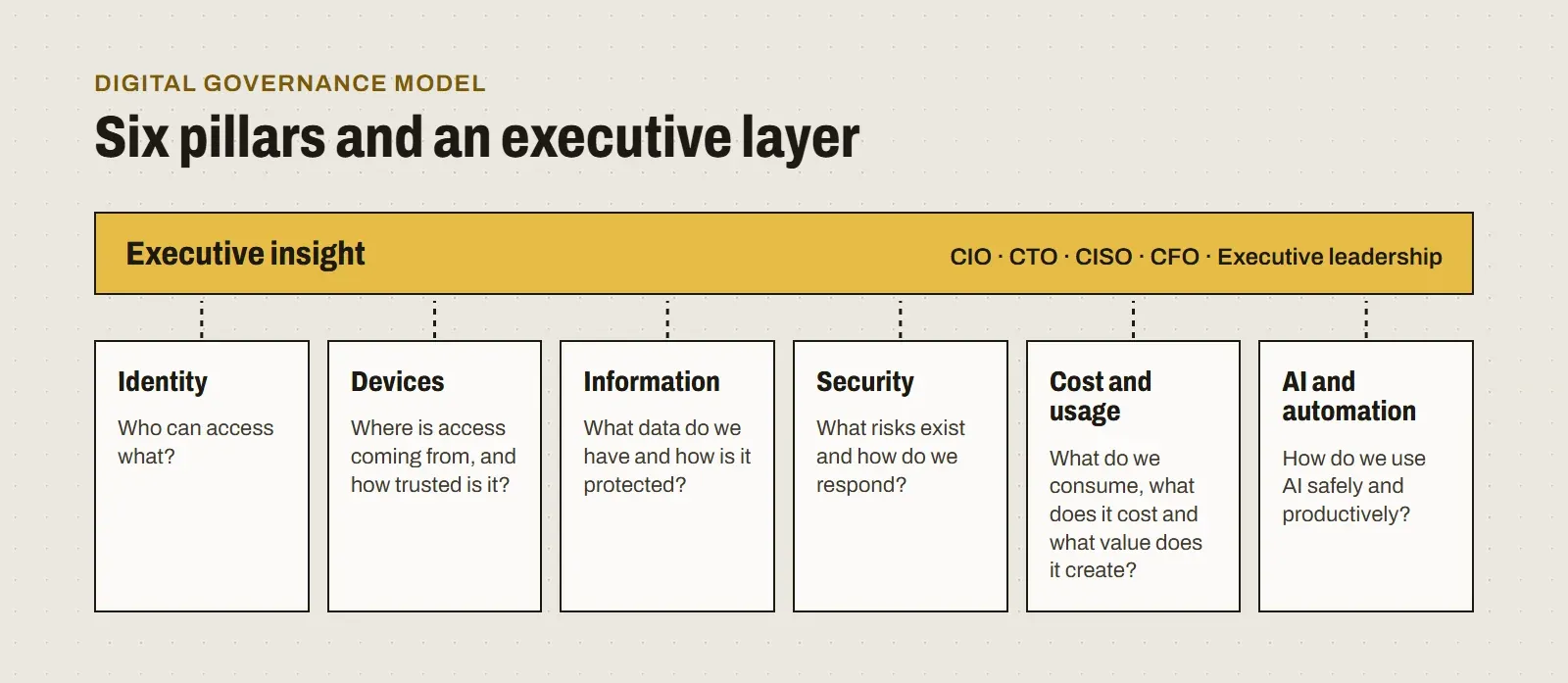
As I see it, it can be organized around six pillars.
| Pillar | Main question |
|---|---|
| Identity | Who can access what? |
| Devices | Where is access coming from, and at what level of trust? |
| Information | What data do we have and how is it protected? |
| Security | What risks exist and how do we respond? |
| Cost and usage | What do we consume, what does it cost and what value does it create? |
| AI and automation | How do we use AI safely and productively? |
Above those six pillars there should be a seventh layer: executive insight.
In other words, turning technical data into indicators that CIOs, CTOs, CISOs, CFOs and executive leadership can understand.
A digital governance dashboard could change the conversation
Picture a leadership meeting.
Instead of showing only ticket counts or service availability, IT presents:
- Identity: MFA coverage, privileged administrators, inactive accounts, external guests and high-risk access.
- Devices: compliance rate, unencrypted devices, vulnerable devices, unprotected endpoints and unsupported operating systems.
- Microsoft 365: assigned licenses, actual usage, underused services, monthly cost and optimization opportunities.
- Security: critical incidents, main risk vectors, identity exposure and how vulnerabilities are trending.
- Data: confidential information detected, external exposure, sites with excessive permissions and policy compliance.
- AI: enabled users, Copilot adoption, deployed agents, usage, detected risks, business cases and estimated return.
Then the conversation changes.
It stops being: Is Microsoft 365 working?
And becomes: Are we properly governing our technology investment and the organization’s digital risk?
That’s an entirely different conversation.
AI will make this role even more necessary
Microsoft notes that the move toward organizations where humans and agents work together will be gradual. Its research calls this emerging model the Frontier Firm and expects organizations to move toward it over the coming years.
Microsoft also reported that 53% of leaders say productivity must increase, while 80% of the global workforce says they lack the time or energy to do their work. According to its productivity signals, workers can be interrupted by meetings, emails or notifications roughly every two minutes during the workday.
Many organizations will respond by automating.
But automating without governance creates new risks.
Every agent raises questions about: identity + permissions + data + security + cost + oversight.
That’s why I believe digital governance will be one of the disciplines that gains the most importance as enterprise AI adoption advances.
Who should own digital governance?
There’s no single answer.
In large organizations, responsibilities will be shared among the CIO, CTO, CISO, data owners, compliance, FinOps, infrastructure and business units.
In mid-sized companies, several of those responsibilities will probably fall to the same team.
What matters isn’t necessarily creating a new title.
What matters is establishing ownership, metrics and visibility.
Someone must be able to answer: What is the real state of our digital ecosystem?
And that answer shouldn’t require logging into ten portals by hand and rebuilding the picture every time leadership asks a question.
A practical path to digital governance
I don’t think this transformation has to happen through a giant project.
It can start gradually.
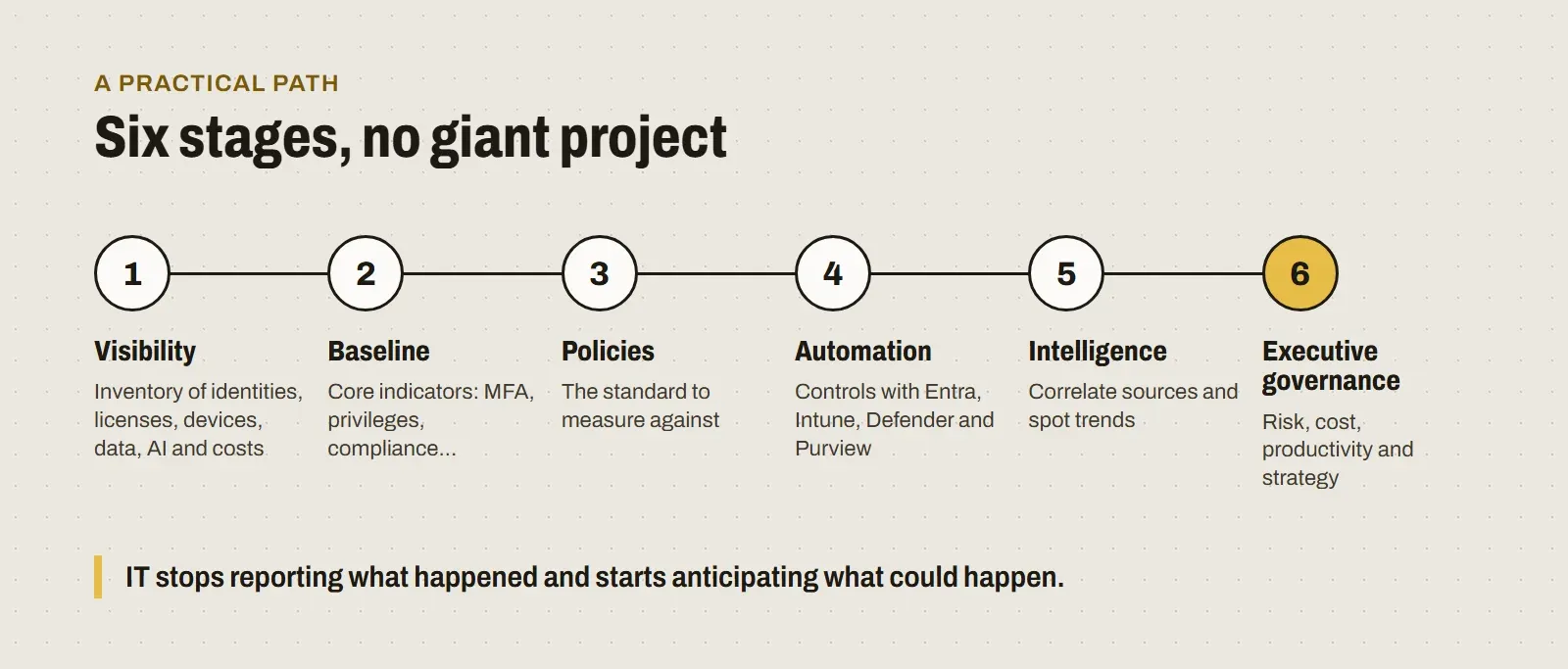
Stage 1. Visibility
Build an inventory of users, identities, licenses, devices, applications, critical information, AI services and costs.
Stage 2. Baseline
Define core indicators. For example:
- MFA coverage;
- number of privileged administrators;
- compliant devices;
- inactive identities;
- external guests;
- license usage;
- risky access;
- exposed information;
- Copilot adoption.
Stage 3. Policies
Decide what the organization considers acceptable behavior.
Knowing a problem exists isn’t enough. You need to define the standard it will be measured against.
Stage 4. Automation
Use Microsoft Entra, Intune, Defender, Purview and other capabilities to enforce controls and cut manual work.
Stage 5. Intelligence
Correlate information from different sources and build dashboards that reveal trends and anomalies.
Stage 6. Executive governance
Turn technical indicators into conversations about risk, cost, productivity and strategy.
At that point, IT stops reporting only what happened.
It starts anticipating what could happen and recommending what the organization should do.
From technology operator to strategic business partner
For many years we’ve talked about getting IT a seat at the leadership table.
Perhaps one way to get there is precisely to change the information we bring to that table.
An administrator might say:
We have 3,000 licenses.
A governance lead might say:
We have 3,000 licenses, 340 show low usage, two applications duplicate functionality and we have a potential optimization opportunity before the next renewal.
An administrator might say:
We have 2,500 registered devices.
A governance lead might say:
94% meet the defined policies; 150 devices need attention and 32 carry a level of risk that requires priority intervention.
An administrator might say:
We’ve enabled Copilot.
A governance lead might say:
Adoption is at 68%. These are the teams using it most, these are the main scenarios, these are the barriers to adoption and these are the information risks we’ve identified.
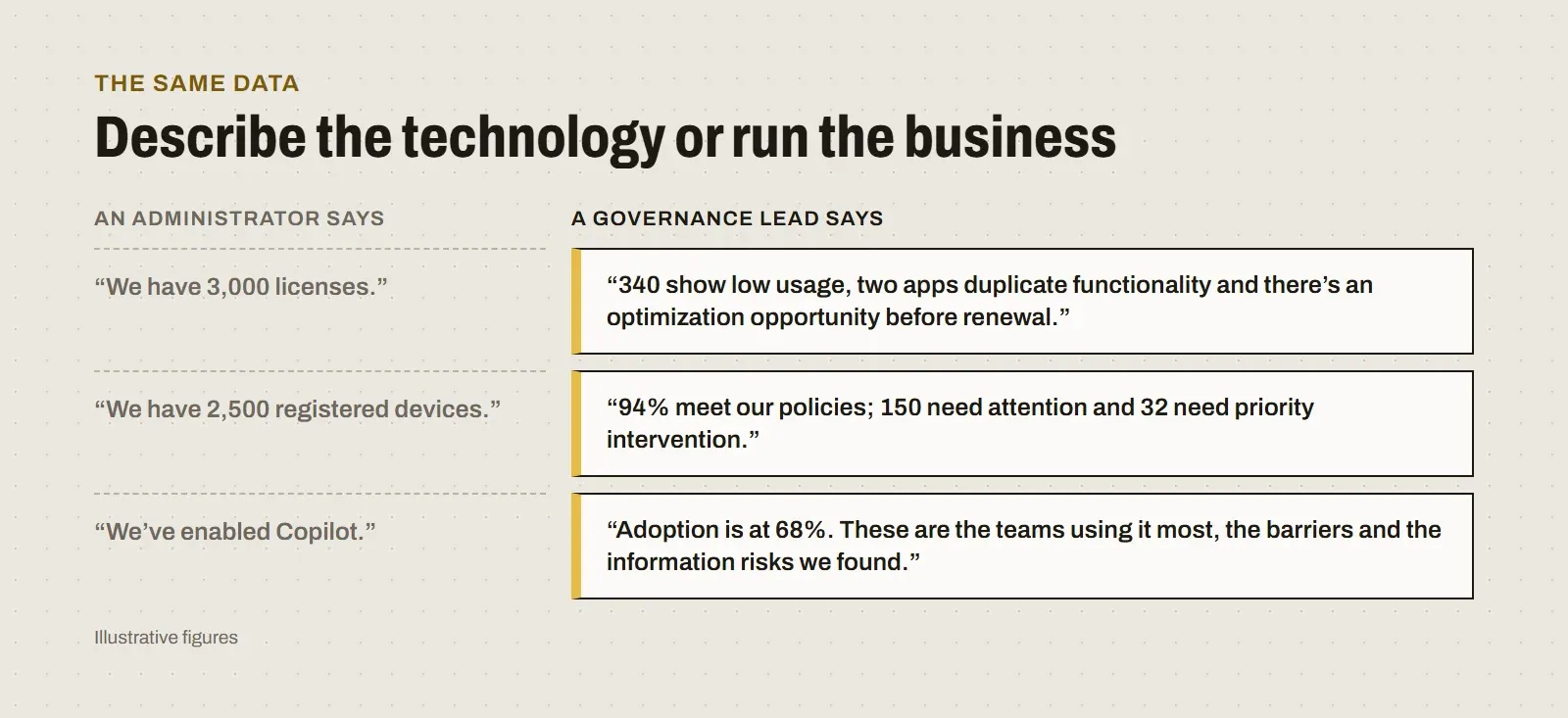
That’s the difference.
The same data can describe the technology or help run the business.
Conclusion: administering Microsoft 365 is no longer enough
From my experience working with the Microsoft ecosystem, I believe we’re facing an important evolution in the role of IT.
Microsoft 365 will still need excellent administrators.
We’ll still need specialists in Exchange, Teams, SharePoint, Entra, Intune, Defender and Purview.
But above operations we need to build another capability: the ability to see the whole ecosystem.
Identities. Devices. Information. Security. Licenses. Applications. Costs. Artificial intelligence. Risk.
And to turn all of it into decisions.
Because when technology becomes a cross-cutting part of the business, its governance must be cross-cutting too.
The next step isn’t just administering Microsoft 365 better.
It’s evolving toward a model where IT can strategically govern the digital ecosystem of the whole organization.
And that may well be one of the most important transformations Microsoft 365 teams will have to make in the coming years.
The question I’d leave open is:
Does your organization have someone who administers Microsoft 365, or does it truly have a vision for governing its entire digital ecosystem?
Sources and references
- Microsoft 2025 Work Trend Index: The Year the Frontier Firm Is Born. Research based on 31,000 workers in 31 countries, LinkedIn data and aggregated Microsoft 365 signals.
- Microsoft Digital Defense Report 2025. Microsoft Threat Intelligence.
- Flexera 2025 State of the Cloud Report. Global research on cloud adoption, costs and management.
- The SaaS Paradox: Growth, Waste and Risk, based on the Flexera 2025 State of ITAM Report.